M.E. Sparks is an artist and educator based in Winnipeg, Treaty 1 Territory, where she is a faculty member at the University of Manitoba School of Art. Sparks holds an MFA from Emily Carr University of Art + Design and a BFA from NSCAD University. She is the recipient of research and creation grants from Canada Council for the Arts, Manitoba Arts Council, Winnipeg Arts Council, BC Arts Council, and Arts Nova Scotia, and was a finalist in the 2017 and 2018 RBC Canadian Painting Competition. Her work has been included in exhibitions at the Gordon Smith Gallery of Canadian Art (North Vancouver), Alternator Centre for Contemporary Art (Kelowna), Trapp Projects (Vancouver), Access Gallery (Vancouver), The Painting Center (NYC), Galerie Shibumi (NYC), AceArtInc. (Winnipeg), Galerie Buhler Gallery (Winnipeg), among others. Sparks has participated in residencies in Canada, Germany, Finland, and the USA, most recently at the Vermont Studio Center and NARS Foundation International Residency.



I work with methods of painting and collage to examine the relationship between surface and image. Through a process of fragmenting and recombining found forms, both art historical and autobiographical, I search for the moment an image loses its representational solidity and orientation. While figurative traces often remain within my paintings, I am interested in how and when a familiar form slips from its origins, resists classification, and evokes a feeling of disorientation.
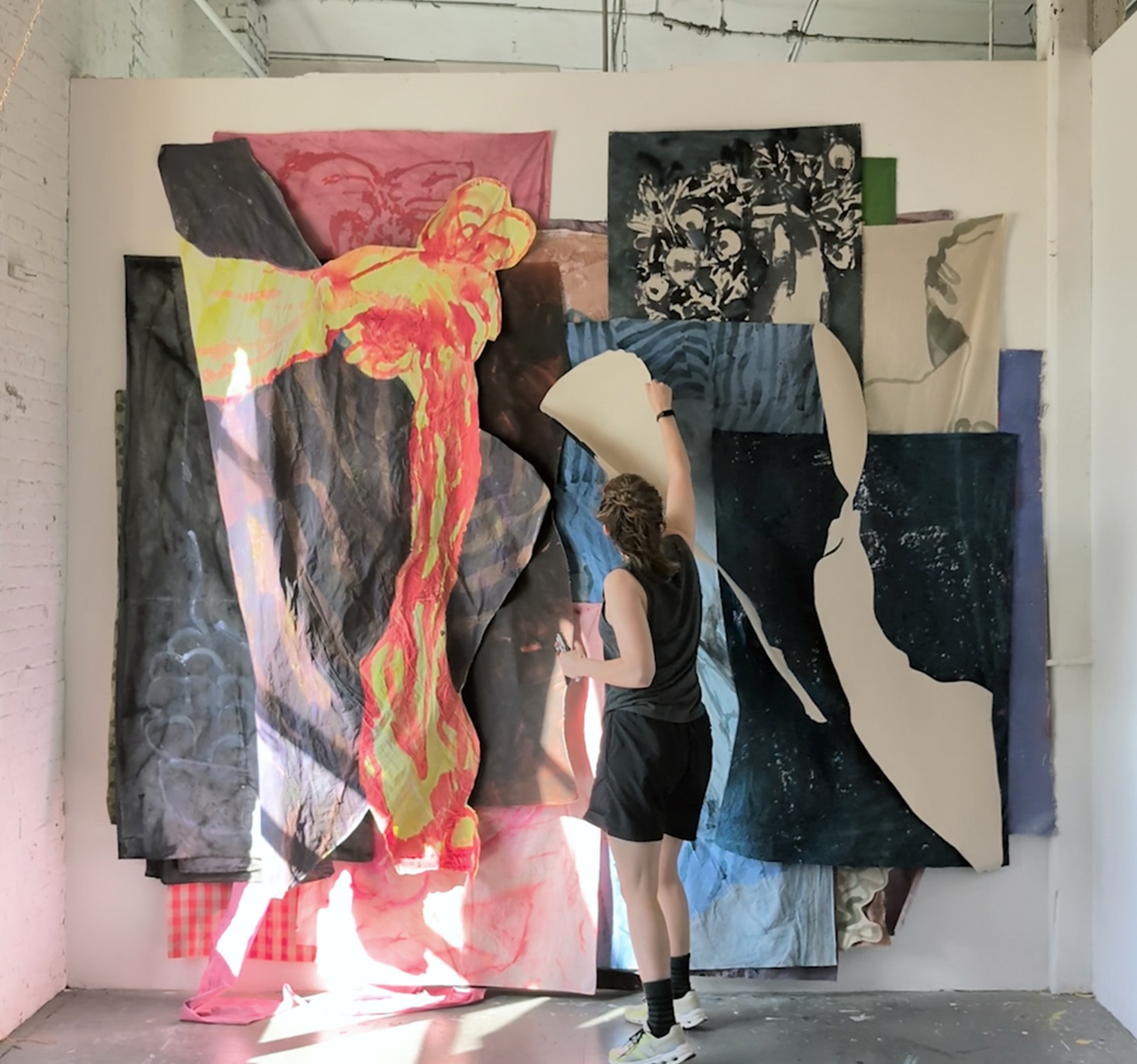
In recent work, this process of abstraction unfolds through the cutting, draping, and layering of painted canvas and recycled fabric. By pulling apart and reassembling once-whole paintings, the art historical images I draw from are distanced from their sources, becoming both faintly familiar signifiers and new, autonomous objects. These image-objects hover at the edge of recognition; I think of them as both resistant and flirtatious forms. They playfully lean into representational space, yet withhold the ease and immediacy of being pinned down, defined, and categorized.
Working with the painted substrate in its unstretched state, I reimagine the flatness and rigidity of painting, along with its history, as malleable, provisional, and unfixed. Modular in nature, the draped paintings defer a finished or resolved end-point by suggesting the possibility of ongoing reconfiguration. Rather than present a linear narrative, this potential for reassembly tempers expectations of legibility, interrupts an immediate reading of the image, and insists on duration.
Across all facets of my practice, I see painting as a space of complication rather than confirmation. I question how a painting can evoke a feeling of disorientation, described by the feminist scholar Sara Ahmed, as “bodily experiences that throw the world up, or throw the body from its ground.” I’m interested in the generative potential that arises through this vulnerability of disorientation, of not being able to name exactly what we see. When we lose our footing within an image (when the body is thrown from its ground) I wonder how this might reorient the ways we observe, categorize, and assign value to images, or meaning to forms.